Voicebox documentation
Pluggable live models
Voicebox separates the agent loop from the model, in the same spirit as Pi’s loop: the host owns tools, policy and lifecycle; a provider translates messages. Switching Gemini to OpenAI changes neither the UI nor the tool catalogue. The live-model seam is separate from coding-agent delegation (Pi/Claude ACP) and from the text-turn resolver.
Four layers, one upstream boundary
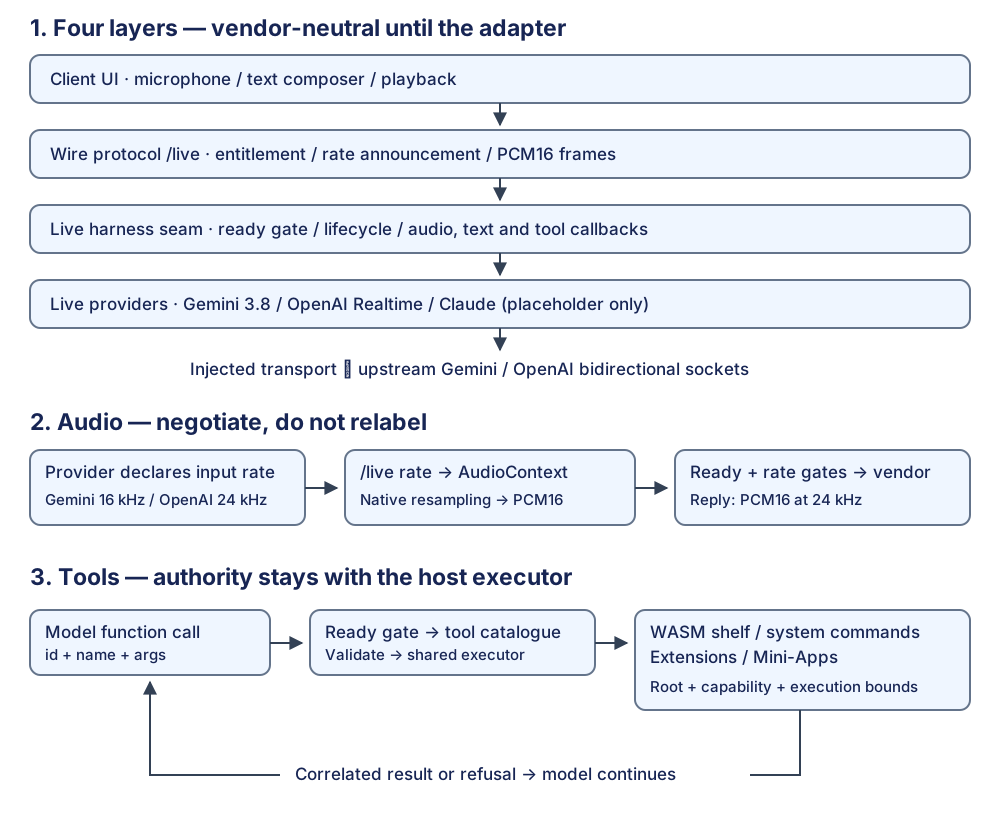
1 Client UI / microphone / playback
                | PCM16 + text + state
2 Wire protocol /live (server: entitlement, rate announcement, frame bounds)
                |
3 Live harness seam (ready gate, lifecycle, callbacks)
                | normalized audio / text / calls / results
4 Live providers: Gemini 3.8 | OpenAI Realtime | Claude placeholder
                | vendor-specific frames via injected transport
   Upstream vendor bidirectional sockets (Gemini / OpenAI only)

   Tool calls leave layer 3 for the host executor, NOT for the UI or provider.
- Client:
public/live-voice.jsandpublic/audio-client.jscapture/play audio. They never interpret vendor frames or receive vendor keys. - Wire:
server.mjsowns/liveentitlement, binary-frame validation and the shared executor. It supplies the catalogue and answers tool calls. - Harness:
lib/live-harness.mjsis the public library entry point;lib/live-session.mjsowns registration, readiness, terminal state and the transport facade. Importing the library starts no server or UI. - Providers:
lib/live-providers/gemini.mjsandlib/live-providers/openai.mjsown vendor setup, events and response encoding.lib/live-providers/claude.mjsis registered but does not implement live streaming; Claude coding-task delegation is a different capability.
The current library uses host runtime capabilities (process.env, Buffer, and a WebSocket implementation supporting connection headers for OpenAI). It is UI-independent, not a claim of zero-server browser portability. API keys remain in the host. The facade mediates trusted in-process providers; it is not a sandbox against malicious provider code.
Library and provider contract
import { createLiveSession, inputRateRequiredBy } from "./lib/live-harness.mjs";

const provider = "openai"; // OPENAI_API_KEY in the host environment
const inputRate = inputRateRequiredBy(provider);
const session = createLiveSession({
  provider,
  voice: "coral",
  onState(state, detail) { console.log(state, detail); },
  onText(text) { console.log(text); },
  onAudioOut(pcm, mime) { /* send bytes to the host's playback sink */ },
});
// After onState("ready"), send PCM16 base64 captured at inputRate:
// session.sendAudio(pcm16Base64, inputRate);
// session.sendText("Hello"); session.interrupt(); session.close();
For tools, pass tools: functionDeclarations() and systemInstruction: liveSystemInstruction() from lib/commands.mjs. Supply onToolCall(calls) to validate each call with commandToAction, execute it through your environment’s bounded executor, and always answer with session.sendToolResponse([{ id, name, response: { result } }]), including refusals. The library never grants filesystem or command authority itself.
Register a new adapter with registerLiveProvider(name, factory, { inputRate }). The factory receives { emit, transport, model, tools, voice, instruction, projectInstruction, systemInstruction, log, debug }. Rates must be positive integers; an undeclared rate is refused by inputRateRequiredBy. Re-registering does not retain an old rate. Existing text-only/test providers may omit it.
| Surface | Contract |
|---|---|
Transport connect(url, options) |
Provider factory dials through the injected host transport; options are { headers?, onEvent }. Returns a boolean, never a socket. Events are plain data: open, message, error, close. |
Transport send(kind, payload) |
Handshake, audio, text or control; returns acceptance by the transport, not acknowledgement by the model. Audio is refused before ready. |
Session/provider sendAudio(pcm16, rate) |
Base64 PCM16. Session checks explicit rate against the registered requirement before forwarding unchanged. Omitted rate uses the registered rate for existing callers. |
sendText(text) |
User text; session gates it on readiness. |
sendToolResponse(responses) |
Correlated { id, name, response } array; returns false if the answer cannot be sent. |
interrupt() |
OpenAI cancels a response; Gemini uses upstream barge-in and logs that no client command is sent. |
close() |
Idempotent session shutdown; exactly one terminal notification. |
connect intentionally belongs to the injected transport, not a second public session lifecycle: a provider factory connects, and optional start() runs after construction. This preserves the readiness gate and keeps raw vendor sockets inaccessible to clients. updateProjectInstruction(text) is an optional capability with a named refusal when unsupported.
Providers emit:
| Event | Data / host callback |
|---|---|
transport-open |
onState("transport-open"); not ready yet |
ready |
Opens the gate; onState("ready") |
output-audio |
{ pcm16, rate } → onAudioOut(Buffer, "audio/pcm;rate=...") |
output-text |
{ text, kind } → onText(text, kind) |
tool-call |
{ calls: [{ id, name, args }] } → onToolCall(calls) only when ready |
closed |
{ code, reason } → terminal onState("upstream-closed", detail) |
error |
{ message } → non-terminal onState("error", detail) |
interrupt, turn-complete |
Playback/turn state notifications |
Model selection and reasoning depth
Select provider, model and voice in Settings; changes apply to the next session. core/agent-settings.ts owns the offered lists and rejects models/voices from the wrong provider.
| Provider | Offered models | Capture / playback |
|---|---|---|
| Gemini | models/gemini-3.8-live (default), models/gemini-3.8-live-extended-thinking |
16 kHz / 24 kHz |
| OpenAI | gpt-realtime (default), gpt-4o-realtime-preview, gpt-4o-mini-realtime-preview |
24 kHz / 24 kHz |
models/gemini-3.8-live sends generationConfig.thinkingConfig: { thinkingBudget: -1 }, while models/gemini-3.8-live-extended-thinking sends generationConfig.thinkingConfig: { thinkingLevel: "low" | "medium" | "high" } (mutually exclusive with thinkingBudget — setting both is rejected by the Gemini Live API). Legacy "models/gemini-3.8-thinking" requests are normalized to "models/gemini-3.8-live-extended-thinking". The existing Live tool-turn retry on upstream close 1011 targets 3.8 Flash (models/gemini-3.8-flash), once, replaying pending text; no Gemini 2 model is offered or used by this live fallback.
OpenAI voices: alloy, verse, shimmer, ash, ballad, coral, echo, sage. The GA setup puts voice under session.audio.output.voice, with PCM formats at 24000 Hz for input and output. Readiness requires session.updated, not just socket open. Preview event aliases for audio/transcripts are normalized; all listed models use the GA session setup.
These are configured identifiers, not a guarantee of vendor account entitlement or model availability. Deterministic tests validate frames and settings; a credentialed session is still needed to verify upstream acceptance and audible quality, especially the requested Gemini 3.8 Live Extended Thinking and fallback endpoints.
Audio streaming and rate negotiation
Provider rate declaration (Gemini 16000 / OpenAI 24000)
       -> /live first frame: {type: "rate", inputRate, provider}
       -> browser AudioContext({sampleRate: inputRate}) -> PCM16 worklet
       -> binary /live frame -> size/even-byte validation
       -> session.sendAudio(base64, inputRate) -> ready + rate gates
       -> provider frame -> vendor

Vendor PCM16 + rate -> output-audio -> onAudioOut -> /live binary -> playback
                         Gemini/OpenAI output: 24000 Hz
The browser resamples through AudioContext; the host does not invent a resampler. Early audio is counted and dropped, not queued. The library rejects a mismatched rate rather than mislabelling bytes. It cannot infer the true sampling rate from PCM bytes: the caller must capture at the announced rate. The current /live binary playback path assumes the two implemented vendors’ 24 kHz output; the library callback carries MIME/rate for other hosts.
Bounded tool execution loop
Model functionCall / response.function_call_arguments.done
  -> normalized {id, name, args}
  -> ready gate -> Voicebox tool catalogue (commandToAction)
  -> shared host executor, declared root + capability policy
       +-- WASM shelf: digest pinned, wall-clock / memory / output bounds
       +-- System commands: validated action, browser capability checks
       +-- Extensions / Mini-Apps: admission + scoped execution
  -> {result: success OR named refusal}, same call id
  -> sendToolResponse -> vendor encoding -> model continues speaking
Root-scoped CLI execution in lib/system-tools.mjs uses lib/git-env.mjs to remove inherited Git hook plumbing before spawning commands, including non-Git commands that may invoke Git themselves. Explicit non-Git environment settings are preserved; this prevents a hook’s repository from overriding the declared working directory, not an OS sandbox guarantee.
The provider cannot run a tool directly. The server’s executor catches execution failures and returns a result for each call, preserving root containment and audit semantics from the text path. Bounds belong to the execution backend (see WASM tools and extension admission); the session is not itself a general tool timeout scheduler.
OpenAI emits conversation.item.create with function_call_output and the original call_id. It resumes with exactly one response.create only after both response.done and all pending tool outputs, whether execution or generation finishes first. Malformed JSON arguments produce a correlated refusal instead of executing an action.
Verification and publishing
tests/live-harness.test.mjs exercises the public entry point, rate registration/refusal, Gemini thinking/fallback, and the OpenAI catalogue roundtrip through a recording socket. tests/openai-provider.test.mjs verifies GA configuration, malformed calls, and both tool-completion orders. These tests make no paid vendor calls. The existing OpenAI browser test drives the server/UI against a local vendor fixture.
node --test tests/live-harness.test.mjs tests/openai-provider.test.mjs tests/live-required-rates.test.mjs tests/live-tools-unit.test.mjs
node scripts/docs-check.mjs --write
node scripts/docs-check.mjs
GitHub Pages builds the documentation with Jekyll using .github/workflows/pages.yml. The entry page is docs/index.md; the theme and Markdown link conversion are configured by docs/_config.yml. Enable Settings → Pages → Source: GitHub Actions once. A push to main touching documentation or the workflow deploys it; a feature-branch push does not replace the published site. Maintainers can also run the workflow manually from main. Full tests and page acceptance remain merger-lane gates before landing.