Voicebox documentation
Voicebox Architectural Overview
Voicebox is a local-first, full-duplex voice and browser workspace for creating files, running sandboxed tools, building interactive Web MCP Mini-Apps, and delegating engineering tasks concurrently across external coding harnesses.
This document provides the high-level architectural overview of the system, its core design principles, end-to-end execution flows, and module ownership map. For detailed auto-generated runtime tables of routes, live models, and environment variables, see 07-architecture.md.
1. Executive Summary & Core Design Principles
Voicebox is architected around five foundational invariants:
- Voice-First Full-Duplex Workspace on
127.0.0.1:- Both the Vite development UI server and the Node.js HTTP/WebSocket host (
server.mjs) bind strictly to loopback (127.0.0.1). - Audio is captured in the browser via an
AudioWorklet(public/pcm-worklet.js) and streamed bi-directionally over the/liveWebSocket (lib/live-session.mjs) to low-latency realtime voice models (Gemini Live and OpenAI Realtime; Claude’s live adapter is a placeholder).
- Both the Vite development UI server and the Node.js HTTP/WebSocket host (
- Explicit Workspace Root Containment (
core/root.ts):- Every file read, write, audit record, and task delegation runs inside an explicitly declared workspace root (
core/root.ts). - Path resolution (
core/paths.ts) rejects any relative path or..traversal that leaves the active root; the machine placement’srealpathpass (existing-ancestor walk-up), dotfile denial and root-kind handling live in exactly one owner (lib/path-auth.mjs), enforced statically byscripts/single-owner.mjs.
- Every file read, write, audit record, and task delegation runs inside an explicitly declared workspace root (
- Single-Owner State Facts (
lib/state-dirs.mjs):- Host state directories (
HOST_DIR,SANDBOX_ROOTS_DIR,HARNESS_CONFIG_DIR,MINI_APPS_DIR) are computed in exactly one module (lib/state-dirs.mjs) and enforced statically byscripts/single-owner.mjs— which also enforces the single computing site for path authorization (lib/path-auth.mjs, declared as code-shapeSITES).
- Host state directories (
- Host-Held Credential Custody:
- Provider API keys (
.api-keys.json), host tokens (.host-token), and remote pairing bearers (.pairings.json) are stored with0600permissions insideHOST_DIRoutside every project workspace root. Browser JavaScript and sandboxed child processes never receive raw credentials.
- Provider API keys (
- Plain-Language, Zero-Shift UI:
- The browser room (
public/index.html,public/fused.js,public/style.css) keeps the microphone at the center of the stage while surfacing files, diffs, mini-apps, and live agent progress in non-blocking popovers and docked drawers. Every refusal names the exact rule and recovery action in plain English (tools/rendered-plain-language.mjs). - The agent’s own contour (
.output-ring path) is a followed, seam-free meter (voicebox-beads-u03k): each painted radius chases the audio with a fast attack and a slower decay, so a pause eases over ~20 frames instead of collapsing the whole amplitude in one (measured: 13.0 units in a single frame before the change), and the ring’s history is traversed mirrored, so the oldest and newest entries are never drawn adjacent (measured: a 9.5-unit step at that wrap before). The data-driven phase and its carrier stay, so a steady note still moves;tests/mic-waveform-animation.test.mjsdrives the real renderer with a wrap-only fixture, a loud→silent step, and a constant input, and asserts all three.
- The browser room (
2. High-Level System Architecture
Voicebox is structured into three cleanly separated layers: the Browser Layer (public/), the Portable Core (core/), and the Host Server & Capability Layer (server.mjs, lib/).
flowchart TB
  subgraph Browser["Browser Layer (public/)"]
    MicStage["Centered Hero Voice Stage<br/>(#mic, public/live-voice.js, public/pip-mic.mjs)"]
    Popovers["Popover Cards & Drawers<br/>(#made-list, #reader, #session, #activity-log-panel)"]
    MiniApps["Double-Iframe Mini-App Sandbox<br/>(public/mini-app-bridge.html, public/apps/agent-monitor.html)"]
    PWA["Offline App Shell & Storage<br/>(public/sw.js, OPFS & Picked Directory Handles)"]
  end

  subgraph Core["Portable Core (core/)"]
    RootPolicy["Workspace Root & Path Containment<br/>(core/root.ts, core/paths.ts, core/policy.ts)"]
    WireContracts["Wire Protocol, Schemas & Audit<br/>(core/wire.ts, core/schema.ts, core/audit.ts)"]
    ExtModel["Extension & Task Contracts<br/>(core/extensions.ts, core/tasks.ts, core/mini-app.ts)"]
  end

  subgraph Host["Host Server Layer (server.mjs, lib/)"]
    LiveBridge["Full-Duplex /live Voice Gateway<br/>(lib/live-session.mjs)"]
    TurnResolver["Turn & System Command Resolver<br/>(lib/resolver.mjs, lib/system-commands.mjs)"]
    TaskManager["Multi-Harness Concurrent Task Manager<br/>(lib/tasks.mjs, lib/pi-acp.mjs, lib/claude-acp.mjs, lib/cli-harness-executor.mjs)"]
    Sandboxes["Wasm Shelf, Extensions & OS Fences<br/>(lib/wasm-shelf.mjs, lib/wasm-worker.mjs, lib/fence-provider.mjs)"]
    StateCustody["Single-Owner State & Credential Custody<br/>(lib/state-dirs.mjs, lib/env-transport.mjs)"]
  end

  MicStage <-->|"WebSocket /live (16kHz/24kHz PCM + Tool Calls)"| LiveBridge
  Popovers <-->|"HTTP /api/* & WebSocket /channel"| TurnResolver
  MiniApps <-->|"MessagePort RPC & Web MCP Tools"| TurnResolver
  TurnResolver --> RootPolicy
  LiveBridge --> TurnResolver
  TurnResolver --> TaskManager
  TurnResolver --> Sandboxes
  TaskManager --> WireContracts
  Sandboxes --> ExtModel
  Host --> StateCustody
Live-model layering
The reusable public entry point is lib/live-harness.mjs; it does not start a UI or HTTP server. Four live-path layers keep vendor protocols below the loop and tool authority in the host:
Client UI -> Wire protocol (/live) -> Live harness seam -> Live providers
                                        |                  Gemini 3.8 / OpenAI
                                        |                  Claude: placeholder
                                        |                       |
                                        v                       v
                                  Shared tool executor    Vendor bidi sockets
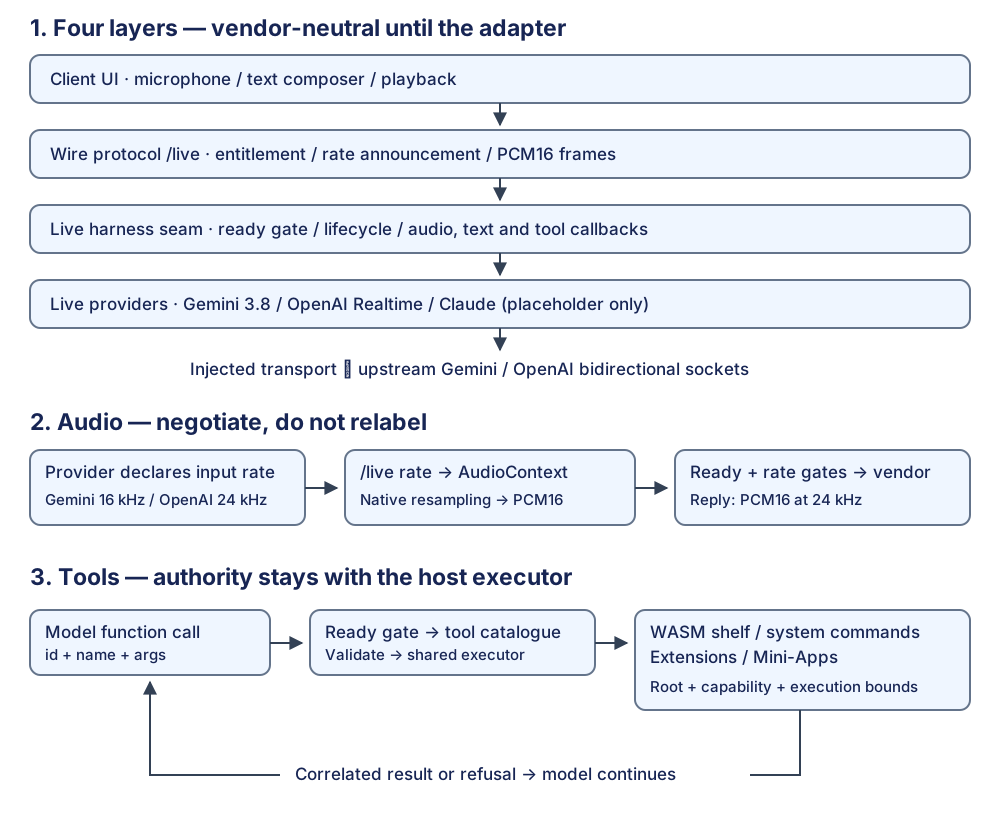
Pluggable live models specifies the provider interface, Gemini 3.8 Thinking budget, OpenAI GA setup, rate negotiation, and bounded tool roundtrip. Library callbacks carry output rate; the current browser wire plays the implemented vendors’ 24 kHz output.
2.1 Browser Layer (public/)
- Centered Hero Voice Stage:
#micsits in the center of the viewport with concentric canvas frequency rings (#freq-rings) driven by live input/output audio analyser nodes (public/live-voice.js,public/audio-client.js).- Supports a floating Document Picture-in-Picture (PiP) Microphone (
public/pip-mic.mjs) so voice controls remain visible and interactive while working in other windows, plus an installable PWA Service Worker (public/sw.jsandpublic/manifest.webmanifest).
- Popover Cards & Real-Time Activity Drawers:
- Files Popover (
#made-list) & Reader (#reader): Displays files created or updated in the active root and opens them in an interactive drawer with edit/save support (PUT /api/file). - Recent Turns (
#session) & Activity Log (#activity-log-panel): Streams real-time voice transcripts, tool invocations, and file mutations over/channelandGET /api/activity.
- Files Popover (
- Double-Iframe Mini-App Sandbox & Agent Progress Tracker:
- Interactive HTML/JS tools (
public/mini-app-bridge.html,public/mini-app-bridge.js,public/mini-app-sdk.js) run inside an outer/mini-app-bridge.htmlhost frame and an innersandbox="allow-scripts"iframe with a strictContent-Security-Policy(default-src 'none'). - Mini-apps register callable tools dynamically via
window.webMcp.register(name, description, schema, handler). - Includes the built-in Agent Progress Tracker (
public/apps/agent-monitor.html,lib/agent-monitor-app.mjs) for monitoring concurrent coding agents, viewing live task output, and cancelling tasks.
- Interactive HTML/JS tools (
2.2 Host Server Layer (server.mjs, lib/)
- Full-Duplex
/liveVoice Bridge (lib/live-session.mjs):- Bridges browser PCM audio to Gemini Live (
lib/live-providers/gemini.mjs) or OpenAI Realtime (lib/live-providers/openai.mjs);lib/live-providers/claude.mjscurrently refuses live audio/text as unimplemented. - Routes tool calls through
onToolCallto the host’s shared executor, which validates the active workspace root and returns structured results; providers never execute tools themselves.
- Bridges browser PCM audio to Gemini Live (
- Turn & System Command Resolver (
lib/resolver.mjs,lib/system-commands.mjs):- Resolves spoken or typed turns into structured verbs:
write,read,list,call(extension/Wasm/mini-app tool),delegate(coding harness task),system(clipboard, theme, panel navigation, mute/interrupt), orsay.
- Resolves spoken or typed turns into structured verbs:
- Multi-Harness Concurrent Task Delegation (
lib/tasks.mjs):- Supports simultaneous connections and parallel task execution across Pi (
lib/pi-acp.mjs), Claude Code (lib/claude-acp.mjs), Antigravity, Codex, and OpenCode (lib/cli-harness-executor.mjs). - Operators can configure multiple ready harnesses (
GET /api/harnesses,PUT /api/harnesses/active) and fan out tasks in parallel (POST /api/tasks/delegatewithharnesses: [...]orharness: "all").
- Supports simultaneous connections and parallel task execution across Pi (
- Sandboxed Execution & Extensions (
lib/wasm-shelf.mjs,core/extensions.ts,lib/fence-provider.mjs):- Runs digest-pinned
.wasmtools inside isolated Nodeworker_threads(lib/wasm-worker.mjs) withresourceLimitsand hard timeouts. - Stages and admits extension packages (
lib/extensions.mjs,lib/extension-approval.mjs) after verifying declared capabilities against the environment tier ceiling (core/tier-table.ts). - Enforces OS-level filesystem and process isolation (
tools/fence.sh,tools/fence-unit.sh) on Linux (bwrap/prlimit) and macOS (sandbox-exec).
- Runs digest-pinned
3. End-to-End Execution Flows
3.1 Flow 1: Live Full-Duplex Voice Turn & Tool Execution
When the user speaks with the microphone active, audio streams over /live and tool calls execute in-process against the active workspace root while broadcasting real-time UI updates over /channel:
sequenceDiagram
  autonumber
  participant User as Operator (Browser)
  participant LiveJS as public/live-voice.js
  participant Server as server.mjs (/live & /channel)
  participant Provider as lib/live-session.mjs (Upstream Model)
  participant Root as Active Workspace Root

  User->>LiveJS: Speaks into microphone
  Server-->>LiveJS: Required input rate (Gemini 16kHz / OpenAI 24kHz)
  LiveJS->>Server: Binary PCM frames captured at negotiated rate
  Server->>Provider: Forward audio chunks
  Provider-->>Server: Tool call (e.g. create_file / open_mini_app / delegate_task)
  Server->>Root: Execute tool inside contained workspace root
  Root-->>Server: Tool result + audit log entry (.audit/)
  Server-->>LiveJS: Broadcast activity & UI event over /channel (auto-open reader/mini-app)
  Server->>Provider: Return structured tool response
  Provider-->>Server: Stream 24kHz PCM voice reply + transcripts
  Server-->>LiveJS: Binary 24kHz PCM frames + transcript events
  LiveJS-->>User: Plays spoken reply & updates stage UI
3.2 Flow 2: Multi-Harness Parallel Task Delegation
Voicebox can delegate a task to one or several coding agent harnesses concurrently (via voice tool call delegate_task or POST /api/tasks/delegate):
sequenceDiagram
  autonumber
  participant Client as Browser / Voice Tool
  participant Server as server.mjs
  participant Tasks as lib/tasks.mjs
  participant Harnesses as Concurrent Runners (Pi, Claude, Antigravity, Codex, OpenCode)

  Client->>Server: POST /api/tasks/delegate { prompt, harnesses: ["pi", "claude"] }
  Server->>Tasks: Validate root & spawn parallel task records
  par Run on Pi ACP
    Tasks->>Harnesses: JSON-RPC session/prompt over stdio (lib/pi-acp.mjs)
  and Run on Claude Code
    Tasks->>Harnesses: JSON-RPC / CLI execution (lib/claude-acp.mjs)
  end
  Harnesses-->>Tasks: Stream output chunks & completion status
  Tasks-->>Server: Persist sealed audit record (.audit/<taskId>.json)
  Client->>Server: Poll GET /api/tasks or view Agent Progress Tracker mini-app
  Server-->>Client: Live per-harness status, elapsed time, and output preview
3.3 Flow 3: Deterministic Browser System Commands
Spoken or typed system commands (copy, paste, open files, open agent tracker, dark mode, stop speaking, clear activity log) are matched deterministically by lib/system-commands.mjs with zero model latency:
parseSystemCommand(transcript)inlib/system-commands.mjsparses the phrase into{ verb: "system", command, target, text, file, mode }.execute(action)inserver.mjsrecords the event in the activity log and broadcasts{ type: "system_command", ... }over/channel.executeBrowserSystemCommand(cmd)inpublic/fused.jsperforms the browser action immediately (copying tonavigator.clipboard, applying the theme throughpublic/theme.mjs, opening the target popover or the Agent Progress Tracker mini-app). It reads the producer’s own field names —modeforswitch_theme,targetforopen_panel— as docs/21 tabulates; audio session commands are parsed and broadcast but not yet consumed by the page (voicebox-beads-cv4g).
4. Module Ownership Map
| Directory / File | Responsibility | Key Modules |
|---|---|---|
server.mjs |
HTTP & WebSocket loopback host, route handlers, /live and /channel upgrade gates, and turn execution coordinator. |
server.mjs |
core/ |
Runtime-agnostic TypeScript contracts, workspace root containment, capability policy, wire envelopes, and audit records. | core/root.ts, core/paths.ts, core/policy.ts, core/tier-table.ts, core/wire.ts, core/extensions.ts, core/tasks.ts, core/mini-app.ts, core/audit.ts, core/environment.ts, core/fleet.ts |
lib/ |
Host capabilities: state directory ownership, browser binary discovery, live voice providers, turn & system command resolvers, multi-harness ACP/CLI runners, Wasm worker shelf, mini-app store, and OS sandboxing. | lib/state-dirs.mjs, lib/browser-binaries.mjs, lib/live-session.mjs, lib/resolver.mjs, lib/system-commands.mjs, lib/tasks.mjs, lib/pi-acp.mjs, lib/claude-acp.mjs, lib/cli-harness-executor.mjs, lib/wasm-shelf.mjs, lib/wasm-worker.mjs, lib/mini-app-host.mjs, lib/mini-app-store.mjs, lib/agent-monitor-app.mjs, lib/fence-provider.mjs |
public/ |
Browser room UI, WebSocket audio client, PCM AudioWorklet, PiP mic, double-iframe mini-app bridge, and PWA Service Worker. |
public/index.html, public/fused.js, public/theme.mjs, public/theme-boot.js, public/style.css, public/live-voice.js, public/audio-client.js, public/pcm-worklet.js, public/pip-mic.mjs, public/mini-app-bridge.html, public/mini-app-bridge.js, public/apps/agent-monitor.html, public/sw.js |
tools/ |
OS sandbox wrappers, Wasm build pipeline, harness discovery CLI, the browser tier’s shard runner, and live page acceptance checks. | tools/fence.sh, tools/fence-unit.sh, tools/build-wasm.mjs, tools/list-harnesses.mjs, tools/page-acceptance.mjs, tools/rendered-plain-language.mjs, tools/browser-shard-runner.mjs |
scripts/ |
Documentation drift generator/verifier, single-owner static check, and pre-push gate orchestration (the per-file tier runner and the gate’s coverage artifact). | scripts/docs-check.mjs, scripts/docs-touched.mjs, scripts/single-owner.mjs, scripts/test-lanes.mjs, scripts/test-shards.mjs, scripts/test-changed.mjs, scripts/gate-tier.mjs, scripts/gate-manifest.mjs, scripts/pre-push.sh |
tests/ |
Concurrent unit tests and isolated live end-to-end integration suites. |
tests/docs-drift.test.mjs, tests/single-owner.test.mjs, tests/system-commands.test.mjs, tests/multi-harness-execution.test.mjs, tests/agent-monitor-miniapp.test.mjs |